

The Mexican Jewish Code
How an Entire Community Evaporated Under the Inquisition’s Nose

“Saved by the great mercies of God from the hands of these Egyptians, I write to commemorate His holy name. In the heart of this darkness, with only my faith to guide me, I leave a living testament for my people, so they may know we did not abandon the Torah of Moses, even as the fire licks our flesh.” Luis de Carvajal the Younger
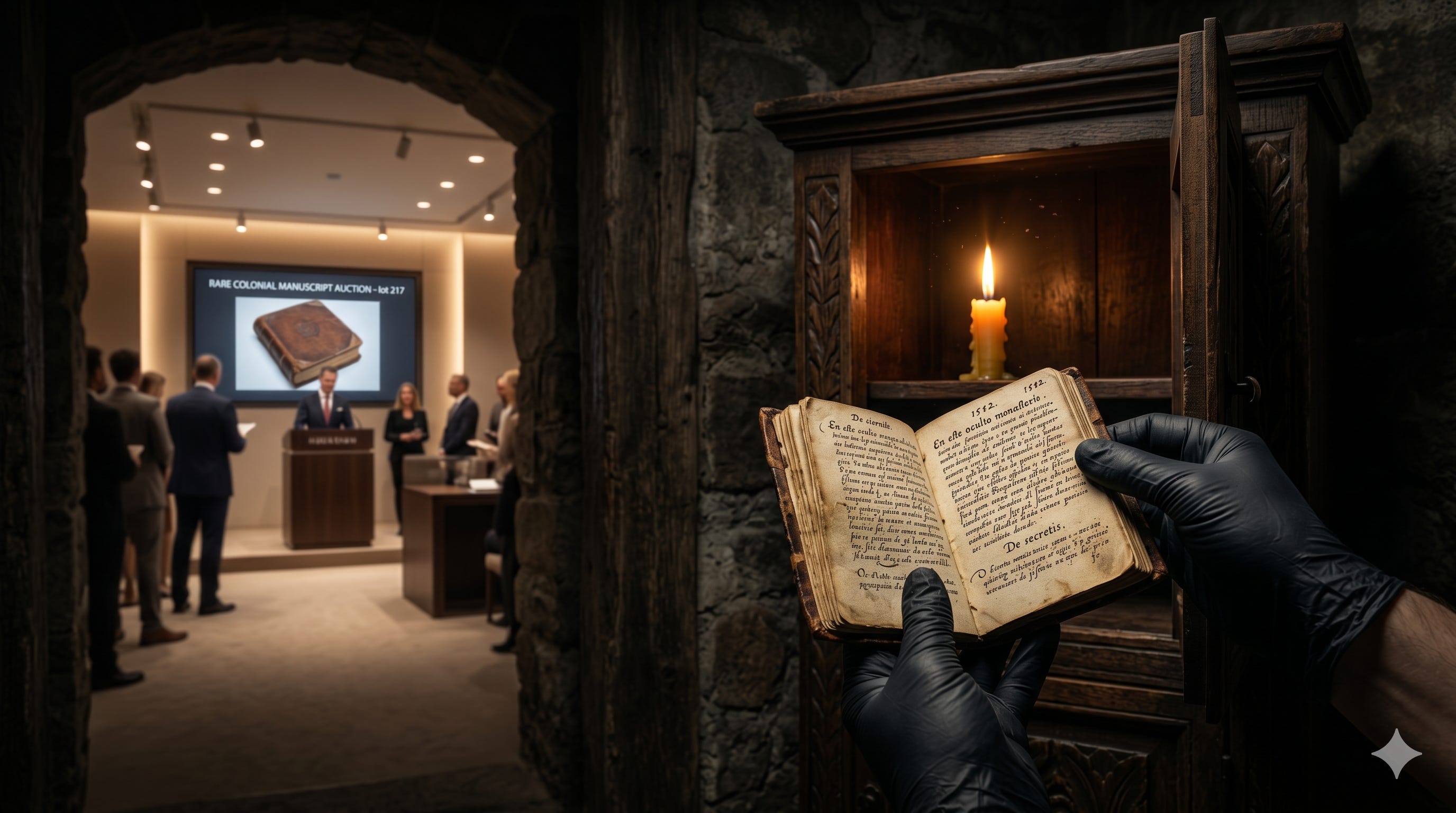
Picture this: It is 2016 in New York City. Amid the multi-million-dollar masterpieces at Sotheby’s auction house sits a tiny, easily overlooked artifact. The catalog describes it dryly as a “colonial religious manuscript.” In that climate-controlled room, no one realizes they are looking at a historical time bomb. Except for one person. An American collector and researcher glances at the item, recognizes the microscopic script, and his heart skips a beat. He immediately contacts the authorities.
This artifact—a pocket-sized leather booklet stolen from the Mexican National Archives 84 years prior—was no ordinary archival document. It was fireproof material evidence of a wild, 300-year saga of survival, betrayal, and underground codes. To understand what this book was doing in New York, we have to cut back in time, straight into the flames of Mexico City, 1596.
In the 16th century, Mexico—then “New Spain”—was the furthest corner of the earth a Jew could flee. Crypto-Jews expelled from Spain and Portugal, officially labeled “New Christians,” hoped to find a haven there, far from the watchful eye of the Inquisition. One of the most influential families in the colony was the Carvajals. The patriarch was the governor of a vast northern province and a loyal Catholic. His extended family, however, fiercely maintained their ancient heritage, orchestrating a massive underground Jewish network.
The spiritual leader of this network was his nephew, Luis de Carvajal “the Younger.” Luis wasn’t just a believer; he was an operator. He traveled between colonies, memorized the Torah to teach it orally, and even circumcised himself with a pair of sharp scissors in the middle of the jungle to maintain the covenant. But their geographic buffer was about to evaporate.
To grasp the scale of this operation, we have to return to ground zero: 1492. The expulsion of the Jews from Spain, followed by Portugal in 1497, presented the Iberian Peninsula’s Jewish population with a brutal choice: convert or get out. Hundreds of thousands chose outward conversion. They were dubbed “New Christians” or Marranos, but many continued practicing Judaism in the shadows.
A significant portion migrated to Mexico. These Crypto-Jews were not a small, isolated sect. Historians estimate that during the 16th and 17th centuries, New Christians—a vast number of whom were actively practicing underground—accounted for 10% to 20% of the European population in Mexico City and other key urban hubs. We are talking about thousands of individuals who formed the backbone of the upper-middle class: merchants, physicians, artisans, and military officers.
Their dispersion strategy was pure geopolitical calculus. In the financial center of Mexico City and vital ports like Veracruz, they dominated international trade routes, controlling the flow of silver and global commodities. Simultaneously, to mitigate the risk of informants, large factions deliberately pushed north into the rugged, arid frontier—provinces like Nuevo León, which span modern northern Mexico, New Mexico, and Texas. Far from the centralized grasp of the colonial government, they established isolated settlements where every neighbor was part of the secret.
The Mexican Inquisition was not merely a band of religious zealots; it was, first and foremost, an incredibly cold, sophisticated, and modern bureaucratic apparatus. It targeted Crypto-Jews through meticulous record-keeping, vast archives, and rigid legal procedures, making it one of the most efficient persecution mechanisms in history. Sound familiar?
The Inquisition’s primary weapon was its crowd-sourced intelligence network. Once a year, churches read the “Edict of Faith”—a highly detailed checklist of suspicious behaviors the public was mandated to look for in their neighbors. Citizens were trained to report anyone who didn’t eat pork, changed their linens on Friday, or failed to light a fire on Saturday. Informants received total immunity, and their identities were kept strictly secret from the accused. This fostered absolute paranoia; a person could not trust their own servants, let alone their family.
Torture was not used as punishment, but rather to extract confessions and names of co-conspirators. The true cruelty lay in the documentation. A formal Inquisition scribe sat in the torture room, recording every word, every scream, the exact methodology used, its duration, and the physiological responses of the accused. The primary techniques included the garrucha (the rack), the toca (controlled waterboarding), or tightening cords around limbs to cause systemic nervous system collapse.
Crucially, the Mexican Inquisition was a self-funding enterprise, which heavily incentivized targeting the wealthy New Christian middle class. The moment an individual was arrested, their entire estate, businesses, plantations, and bank accounts were frozen and confiscated by the tribunal. This capital funded the salaries of the bureaucrats, inquisitors, and informants. The math was simple: the wealthier and more connected the merchant, the greater the institutional incentive to prove their guilt, dismantle their commercial empire, and split the spoils.
The Fall of the Carvajal Empire
The Carvajal family ran directly into this meat grinder, representing the greatest tragedy of the New World. The elder Luis de Carvajal was a seasoned conquistador of Jewish descent who managed to win the absolute trust of King Philip II of Spain. The King granted him an extraordinary royal charter to settle and govern Nuevo León. The old governor was uniquely permitted to bring settlers without vetting their religious ancestry or “purity of blood” (limpieza de sangre), a standard requirement in Spain. He used this loophole to bring his sister Francisca, her husband, and their children.
The Inquisition marked the governor’s family as a strategic target. Taking them down meant seizing immense wealth and demonstrating absolute ecclesiastical dominance. The family was first arrested in 1589. They were severely tortured, forced to publicly recant, and released under heavy surveillance. Undeterred, Luis the Younger and his family immediately resumed their clandestine practices.
Following their second arrest in 1595, inquisitors identified Luis as the spiritual mastermind, but targeted his sisters—particularly Isabel—as the weakest links in the chain. Records in the National Archives of Mexico detail how the sisters were bound to the rack. Under the strain of tightening ropes and water torture, isolated in absolute darkness, they broke. Physical and psychological collapse forced Isabel to name names. She described how her brother Luis read from forbidden religious texts and how the entire family secretly observed Yom Kippur. These confessions sealed the family’s fate and triggered a mass wave of arrests that paralyzed the entire community.
The morning of December 8, 1596, was the ultimate spectacle for the Spanish regime in Mexico City. The central plaza—today’s Zócalo—was transformed into a massive stage. Thousands of citizens, clergy, soldiers, and colonial officials packed the square in a carnival-like atmosphere of public execution.
The archival records describe the procession: the Carvajal family was led out barefoot, dressed in the sambenito—yellow capes of shame painted with red crosses, upward-pointing flames indicating their sentence of burning at the stake, and depictions of demons. High, pointed hats detailing their heresies were placed on their heads. Luis the Younger marched holding a book of Psalms, trying to maintain eye contact with his mother and sisters to steel their resolve.
Standard Inquisitorial protocol dictated that defendants who confessed at the last moment and accepted Christianity were granted a final “mercy”: they were strangled to death via the garrote before the fire was lit, sparing them the agony of being burned alive. Records indicate that Luis’s mother and sisters were strangled on stage in this manner. Regarding Luis the Younger, accounts diverge. Some sources state he refused to recant until the very end and was burned alive while fully conscious; others claim he, too, was strangled before the flames consumed his body. Their remains were burned to ash and scattered to erase any trace of their existence.
What the Inquisition did not know was that at that exact moment, stitched into the lining of Luis’s clothes or hidden among the papers seized from his cell, was his tiny notebook. They thought they had incinerated the evidence, but their own dry bureaucratic logs, paired with his microscopic script, became their historical indictment.
Following the execution, tribunal assistants cleared the cells and sorted the confiscated property. Among the discarded papers and debris, they found Luis’s pocket-sized leather booklet. Opening it, scribes found microscopic, dense, and precise Latin and Spanish script containing prayers, the Ten Commandments, and the family’s memoir. They filed it away inside the family’s official court dossier, bound it in leather, and placed it on the shelves of the Inquisition archives in Mexico City. They assumed the case was closed and the book buried forever.
To survive for three centuries without holy books, institutional synagogues, or contact with mainstream global Jewry, the Crypto-Jews developed a sophisticated operational security protocol that turned their religion into an invisible lifestyle.
Camouflaged Rituals: Shabbat was observed in windowless rooms. Women lit oil lamps deep inside closets or within clay pots so the light wouldn’t betray them to inspectors on the street.
Holidays as Gaming: Festivals like Hanukkah were disguised using local gambling tops called topo (the precursor to the dreidel), ensuring any casual observer saw nothing more than an innocent, secular gathering.
Dietary Deflection: Meat was slaughtered secretly at night. Avoiding pork—the primary red flag for Inquisition informants—was excused to neighbors and servants as a chronic health condition, a digestive allergy, or personal preference.
Structural Textual Revision: Because a single scrap of Hebrew text equaled an immediate death sentence, prayers were fully translated into Spanish. To protect the practitioner, they were altered to include phrasing that mimicked standard Catholic liturgy. They leaned heavily on Psalms, which were acceptable to the Church, passing these prayers down orally from mother to daughter.
The Family Code of Silence: Children were raised as devout Catholics, baptized, and sent to church to avoid local suspicion. Parents withheld their true lineage out of fear that a child might slip up outside the home. Only when a child reached the age of maturity (around 12 or 13) were they brought into a secluded back room. In a stark, intimate ritual, the family secret was unveiled, and they were sworn to a lifetime of absolute silence.
The Geopolitical Escape Hatch
As the Inquisition tightened its grip on Mexico City, the Crypto-Jews recognized that the only way to sustain their way of life was physical decoupling from the administrative center. Their geopolitical solution was to head out to the frontier—the harsh, remote deserts of northern Mexico.
The premier example of this strategy was the founding of Monterrey, the capital of Nuevo León. The city was established primarily by New Christian and Crypto-Jewish families under the initial charter of the elder Governor Luis de Carvajal. The sheer distance from Mexico City provided a natural defense mechanism. The northern deserts lacked a church on every corner, and there were no colonial officials checking the contents of cooking pots.
In the northern frontier, they built a network of isolated agricultural and commercial settlements where neighbors were almost exclusively relatives and co-conspirators. This structure allowed them to dominate northern trade routes, build massive cattle industries, and accumulate vast economic wealth that was relatively shielded from asset forfeiture by the central tribunal. The trauma of the regime was so deeply institutionalized that even when the Inquisition was officially abolished in the early 19th century, these families stayed underground, passing down the secret like a fixed cultural and genetic code.
At the turn of the 21st century, three centuries after the Carvajal family’s fires cooled, a wave of anomalies began emerging across the American Southwest and Northern Mexico. Devout Catholics living in New Mexico, Texas, and northern Mexican states noticed peculiar customs practiced by their elders that did not align with conventional Catholicism.
They discovered traditions of covering mirrors during mourning, burying the dead within 24 hours without Catholic iconography, lighting candles on Friday nights deep inside cabinets, and meticulously sweeping the home toward the center of the room before the weekend.
The definitive breakthrough arrived with modern commercial DNA testing. Thousands of Hispanics in these regions who underwent genetic testing discovered highly elevated percentages of Sephardic Jewish ancestry tracing directly back to the 1492 expulsions. Modern science illuminated exactly what the Inquisition had spent centuries trying to erase.
When Luis’s manuscript was stolen from the National Archives of Mexico in 1932, historians assumed the tangible evidence of Crypto-Jewish resistance was gone for good. The tiny notebook, written in a dungeon and smuggled in clothing, circulated through the black market of private antiquities collectors, hidden from public view.
Then came 2016 at Sotheby’s. Thanks to the sharp eye of that American researcher, the item was flagged as stolen national heritage. A philanthropist stepped in, purchased the manuscript, and formally returned it to the Mexican government.
Today, the booklet is housed in the National Museum of Anthropology in Mexico City. Standing before that glass display case, looking at the yellowed pages and microscopic letters that survived centuries of decay, the historical irony becomes clear: The Inquisition failed.
It managed to burn the Carvajals in the public square, but it could not incinerate their words. The diary stitched into a coat lining became the final verdict against its persecutors, closing a historical circle that began in the flames of 1596 and ended with the victory of genetics, memory, and archaeology in the 21st century.
Today, these descendants—often called the Bnei Anusim—are undergoing a massive awakening, learning Hebrew, reclaiming their heritage, and forming new communities. It turns out that while you can bureaucratize human slaughter and seize assets with flawless paperwork, you can’t fully crush an encrypted cultural code once it hits the desert.
Thank you for reading! If you enjoyed this dive into historical counter-surveillance, feel free to hit the like button and share this post.
Thank you for this article. I have wondered about this for many years. When I was very young I gave birth to a baby girl. I gave her up for adoption. Years later she found me and I met her and her family. Her mother was a Mexican and Jewish. My daughter had also converted. It seemed strange to me as to her mother’s heritage. So now I understand it completely. Thank you.
Fascinating in depth researched history of the Mexico Inquisition. Interesting fact based evidence of the hidden religious observances by Sephardic Mexican ✡️, during and after the Inquistion The discovery of a manuscript artifact at an auction in 2016 This significant artifact was linked to the "Bnei Anusim", descendents of Sephardic✡️ from the Mexico Inquisition, reclaiming their heritage